Good question. At Nauset Environmental, a “mold inspection” and an “indoor air quality assessment” are basically the same thing. Let me explain.
When someone is reacting allergically to an indoor air contaminant, it is usually not just one contaminant. Indoor dust is a mixture of particle contaminants (mold spores, skin scales, pet dander, dust mite fecal pellets, pollen, soot from fireplaces and/or wood stoves, others). We are all at least mildly allergic to one or more of these particulates; some more than others.
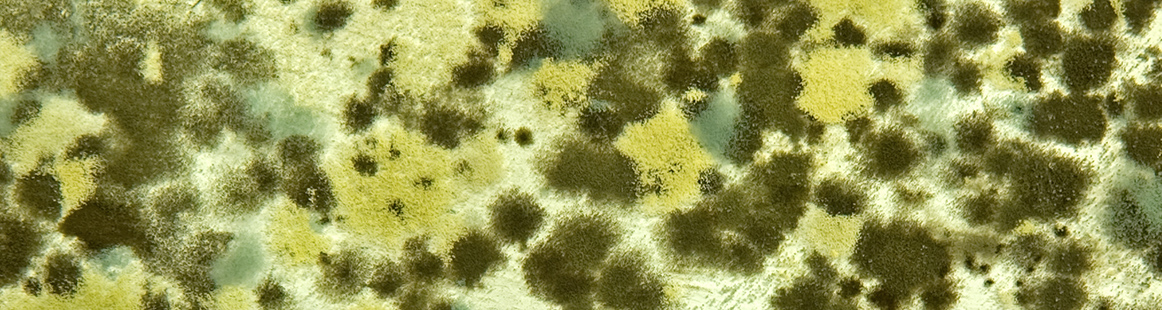
Mold spores are a special case, however. They are the one indoor air contaminant that when exposed to the right amount of moisture can activate and amplify. That means a single spore can turn into a colony of millions. None of the other common indoor air contaminants are capable of doing that. And few match mold’s “allergenicity”.
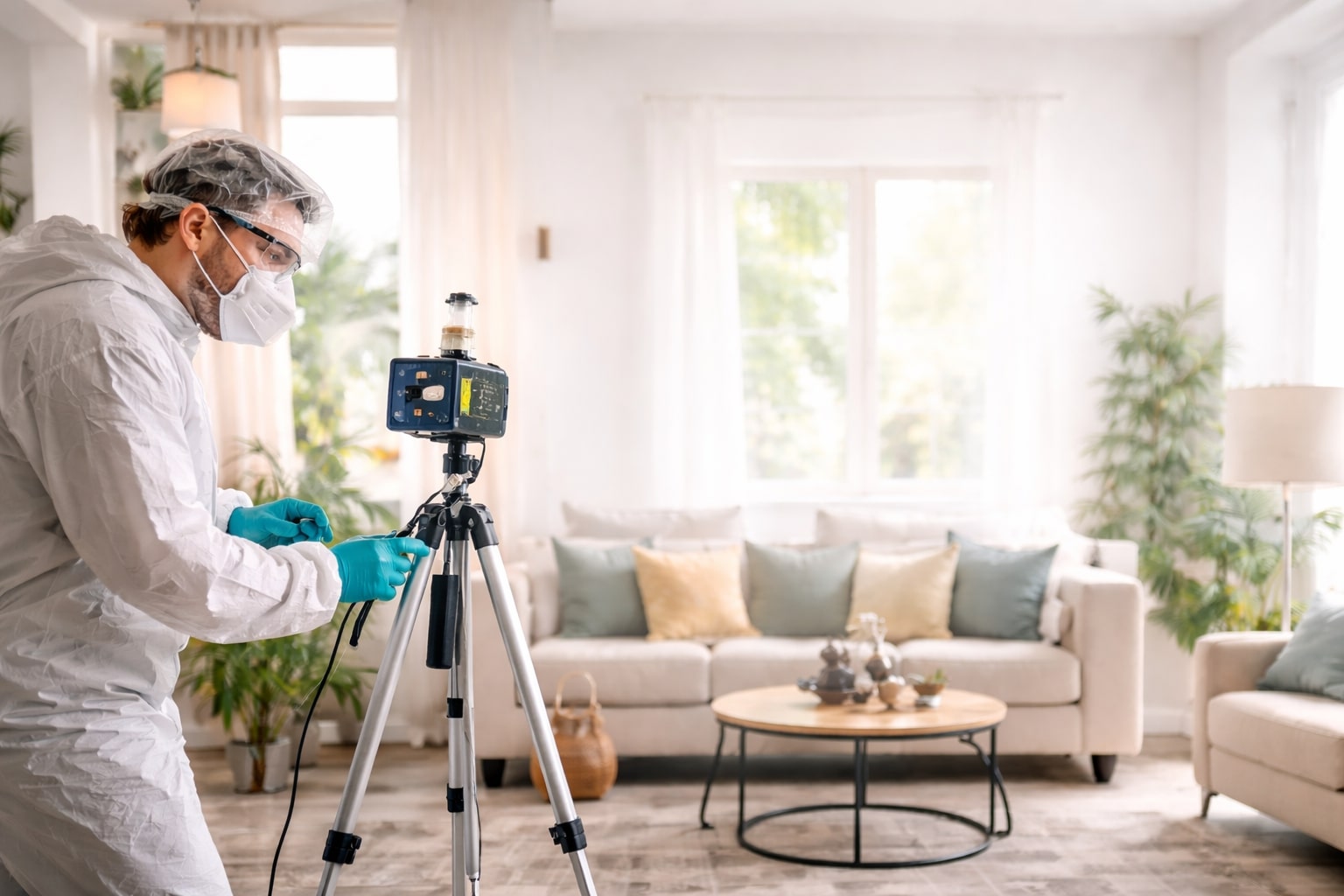
Fortunately, measuring the concentration of mold spores suspended in a room’s air is relatively easy to do. It requires air sampling. But not just any type of air monitoring will do. At Nauset Environmental we specialize in fan-disturbed air monitoring. Most investigators do “quiescent” sampling (if they do any air monitoring at all).
In our experience, quiescent sampling offers little value because mold spores reside in a home’s settled dust. Think about it. What value is there in an investigator walking into a quiet home and collecting a quiet air sample? Homes are lived in. The greatest exposure is when the house is at its busiest; when the home’s settled dust is being kicked up into the air. The smaller the particle, the longer it stays suspended in the air available for us to inhale it. It is the microscopic particles (like mold spores) that are capable of reaching the deep recesses of the lungs and doing the most harm.
At NES we believe we provide the greatest value by evaluating your indoor air on your home’s worst day, i.e., when it is full of family stirring the dust up (think upholstered furniture, bedding, carpeting, etc). Our air monitoring approach is therefore centered around “fan-disturbed air monitoring”. We use a fan to stir things up a bit before we collect an air sample.
Importantly, we apply the same technique and approach to every job, every time. This allows us to make ‘apples to apples’ type comparisons from one home to the next. We have a large database and know when we measure an elevated mold spore concentration. We also know from our years of experience when it is appropriate to deem a space “mold-healthy”.Who does the mold inspection is important. Many inspectors are employed by (or have financial arrangements with) remediation contractors. NES is independently owned and operated by Certified Industrial Hygienist (CIH), Tom Knight. We are scientists and do NOT have any conflicts of interest. “The CIH designation is widely considered the “gold standard” for professionals in the occupational health and safety field. It is not just a certificate of attendance; it is a highly rigorous, globally recognized credential that signifies a master-level understanding of chemical, physical, and biological hazards.”